Arabella: Milwaukee, 1907
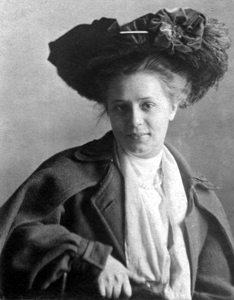
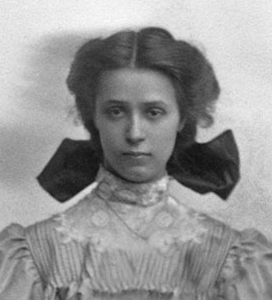
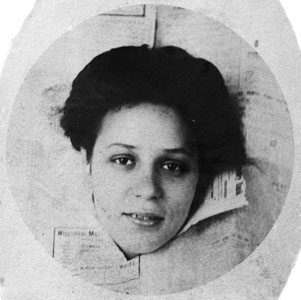 Arabella Jahn at age 14 and 15
Milwaukee Daily News, Friday September 4, 1908
FIND GIRL’S BODY NEAR COUNTRY CLUB
ARABELLA JAHN, AGED 17 YEARS, ENDS HER LIFE WITH CARBOLIC ACID
Coroner Gets Report That Girl Telephoned to Man Aquaintance From Saloon on Whitefish Bay Road – Was Not in Love, Declares Father of the Victim
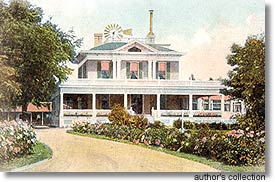
Two men strolling near the Country club on the Whitefish Bay road early this morning found the body of a beautiful young girl. In one hand was clutched an empty carbolic acid bottle plainly indicating that the girl committed suicide. Worried by his daughter’s absence from home all night, Henry Jahn, a barber in the Railway Exchange building, who resides at 430 Lloyd Street, identified the corpse several hours later as that of his child, Arabella, 17 years of age. Hard to Control, Says Father Tearfully and in a broken voice Jahn told the attendants in the coroner’s office that Arabella was a reserved, distant, haughty, willful girl who rebelled affection. |
 |
“She was the opposite of her tender-hearted, impulsive brothers and sisters,” he said. Arabella’s queer nature made me fear an end like this.
“Poor girl, we all loved her, but she wouldn’t mind. She left home at 4 o’clock yesterday afternoon. Her mother wanted her to stay home but she was defiant and answered: ‘I’ll show you.’ And here she is, a corpse. The sorrow of it is hard for me to bear, but I tremble when I think of mother, I don’t know how to tell her.”

Take Body From Morgue
Jahn recovered from his emotion and arranged to have the body removed to an undertaking establishment.
“Was she ever in love?” asked Deputy Coroner Glenn, remembering the tatooed names, “Arabella and Arthur” on the calf of the left leg of the body.
”No, I believe not,” Jahn replied.
However, it was reported to Acting Coroner Luehring that Miss Jahn entered a saloon on the Whitefish Bay road at midnight and telephoned to a man in an East side flat building. It is said that she asked the fellow to meet her. Her manner betrayed that his reply was a keen disappointment.
The theory is that Miss Jahn committed suicide soon after she left the saloon while brooding over a broken appointment.
Milwaukee Sentinel
GIRL COMMITS SUICIDE
Seventeen Year Old Daughter of Henry Jahn Drinks Acid Near Country Club
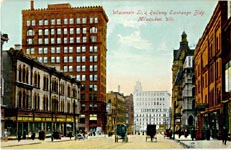
Arabella Jahn, aged 17 years, committed suicide early Friday morning by drinking carbolic acid, in the grass across from the Country club on the Whitefish Bay road. Her body was not identified until several hours later when her father, Henry Jahn, a barber in the Railway Exchange building, worried over his daughter’s absence, called at the morgue. The girl left home Thursday afternoon at 4 o’clock and she failed to return Thursday night. No reason is known for the young woman’s act. Her father saying yesterday that there was a no love affair connected with his daughter’s life. According to Mr. Jahn she was headstrong and the opposite, temperamentally, from her brothers and sisters. |
 |
The body was removed to the undertaking rooms of Foss & Nicolai yesterday. The funeral arrangements have not been made but services probably will be held in the family home, 430 Lloyd Street.
Northwestern, September 4, 1908
Couldn't stand scolding
Seventeen Year Old Milwaukee Girl Takes Her Own Life
(Special to the Northwestern)
Milwaukee, Wis., Sept. 4 - Scolded by her mother for her restless spirit Arabella Jahn, aged seventeen years, ran away from home and committed suicide by drinking carbolic acid. She died within a few feet of the entrance of the Country club on the White Fish Bay road. The body was found this morning at six o'clock. While everything was gay at the Country club Thursday night, music playing and dancing going merrily on, the girl sat on the grass near the entrance and in plain view of the club contemplating ending her life.
This morning the father, Frank Jahn, proprietor of the barber shop in the Railway Exchange building, with his brother visited the morgue and identified the body of his daughter. He burst into tears at the sight of her body. He said he had feared Arabella would commit suicide.
[ Ed. note: Note that this story confuses her uncle Frank with her father Henry Jahn. ]
Milwaukee Journal, Friday September 4, 1908
FIND GIRL SUICIDE IN GRASS; LIMB IS STRANGELY MARKED
MYSTERY IN HER DEATH
NAMES “ARABELLA” AND “ARTHUR” TATOOED ON HER.
Said to Have Been Rebuffed at Telephone Last Night by Down-Town Man and Then Left Saloon Near Which She Was Found Dead Early Today – Father Says He Knows of No Reason for Suicide, But Declares She Has Always Acted Strangely and Repulsed Affections of Those Near to Her.
Lying in the grass, across the road from the Country club, with her face upturned to the sky, the body of a girl was found shortly after daybreak today.
Near the head was a bottle labeled carbolic acid.
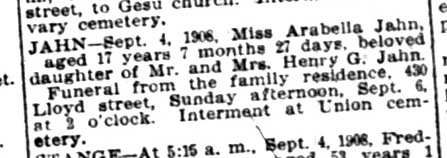
The body was taken to the morgue and it was later identified as that of Arabella Jahn, aged 17, daughter of Henry Jahn, 430 Lloyd st. ARABELLA-ARTHUR IS TATOOED ON HER LEG. Before identification was made, a search of the clothing for a note or any mark which might throw light upon the mystery was without result, but upon the calf of the left leg was tatooed the name Arabella and under it the name Arthur. Mr. Jahn, worried by the absence of his daughter, made a search this morning which resulted in his finding her at the morgue. |
 |
When shown the body, he burst into tears.
WORRIED ABOUT HER; SHE ACTED STRANGELY.
“She left home about 4 p.m. yesterday,” said he. “Her mother asked her not to go out, but Arabella said: ‘I’ll show you’ and a little while after, when her mother looked for her, she was gone. “She always was a strange girl – cold and not responsive to the affection of her parents, sister and brothers. “She was not communicative. We worried a great deal about her.” “She had never been in any serious trouble of which I know, but she was unlike the other children, and I sometimes feared she might come to such an end as this.
NO KNOWN REASON FOR TAKING HER LIFE.
“She had no love affair, nor any reason to take her life of which I am aware. “She was very headstrong, and when she determined to do anything neither reasoning nor expostulation could make her change her mind. “She did not have to work. She stayed at home, and both her mother and I tried to make her life happy.” The body was removed from the morgue to undertaking rooms.
TELEPHONES TO MAN; TURNED DOWN; DIES
At the morgue it is stated that the girl, shortly after midnight, went into a saloon not far from the Country club and telephoned to a man in a downtown flat building asking him to meet her, but he refused and the girl then left the saloon.
It is believed she walked across the road, lay down in the grass and committed suicide.
Mr. Jahn has a barber shop in the Railway Exchange building.
Milwaukee Journal, Saturday September 5, 1908
WAS SUICIDE CARRIED ABOUT?
COUNTRY CLUB CADDY HAS SUSPICIONS.
Believes Girl Whose Body Was Found Yesterday Died at Her Own Hands – but, Position of the Corpse, as Well as Fact That They Can’t Find Cork to Acid Bottle, Leads Him to Ask Questions.
Where did Arabella Jahn die? Was it at the spot where her body was found in the grass, across the road from the Country club, yesterday morning? Or, after she died elsewhere, was her body carried there and left to be found by the chance passer? G. W. Crane, caddy-master at the Country club, who found the dead girl, believes the latter.
NO SIGNS OF STRUGGLE. “I do not believe she died where I found her,” said Mr. Crane today. “There are several peculiar circumstances that strengthen me in that belief. “Her clothes were not disordered in the least. The body was lying upon the back as though asleep. Those who die from carbolic acid poisoning are apt to struggle and disarrange the clothing. “The grass in which she was found was about 8 inches high. It was not beaten down, showing that there was no struggle. Her hat was pinned to the head and the empty bottle lay close to the hand. |
 |
NO CORK NEAR BOTTLE.
“The strangest circumstance of all is that there was no cork near the bottle. I had several boys search for it for half an hour. “It is not credible that the girl would have proceeded to that point with an uncorked bottle of carbolic acid. “I am not prepared to say that the girl met with violence. In fact, I believe she committed suicide. “But I do not believe she committed suicide at the place where the body was found. “If she had met her death at the hand of others there would in all probability have been marks of violence upon her. But there were none.”
Milwaukee Free Press, Monday Morning, September 7, 1908
THE CASE OF THE GIRL
The wretched end of the unfortunate girl which was chronicled in the press last week is typical of an ever increasing number of similar cases. They all tend to illustrate an unfortunate condition: The increasing waywardness of city girlhood, and the seeming impotence of parents to deal with it.
It is a lamentable state of affairs and one that is reaping even more lamentable consequences.
There is something so infinitely tragic in the thought of this pretty maid of seventeen dying by her own hand, alone, in the darkness, like a rat in a corner, that the human heart spontaneously cries out in terrible remonstrance. In the blush and rose of girlhood, with a good home, kindly parents and none save legitimate cares, need this have been the end?
No, a thousand times, no. The cause here, as in all similar cases, is the lure of exciting pleasures, the craving for the so-called “good time” that must be had at any cost.
In the old days, the girl of humble station was content with her family circle, the friends at school and neighborhood and those simple pleasures which come legitimately to young womanhood. She was satisfied to remain at home in the evening, visiting, or engaged in those feminine duties that are now considered a drudge.
Today, this is all changed. While still in short skirts, the premature and sophisticated miss whose home is not “swell” enough for her begins to walk the street corners, frequents the cheap theaters and turns longing eyes toward automobiles and Bohemian restaurants.
Parents implore and threaten, but their words are of no avail. The girl is out nightly on some pretext or other – where and with whom she does not care to say. The mother hopes for the best. She dare not guess that the “best” is the pace that kills – surely the soul, often the body. Then one day comes the awakening – when it is too late.
This impotence of parents to restrain their young daughters is astounding. In many cases, no doubt, they do not care. They think the girl is having a good time, that is all. But in many, many cases, they do care, but stand by helpless seeing their child walk down the road to ruin.
What is needed here, is good, old-fashioned parental authority. Every father, mother, brother, should know that when a girl is out, night after night, no good is a’brewing. The girl should be forced to give an ccount of herself, or be made to feel the rod of iron. Likewise, if she does not desist in her course. If she is utterly incorrigible there is but one place for her – the reform school. Better that, where she may quiet down and come to her senses, than a greater shame and misery.
If every family that holds a headstrong, wayward girl, would look into her case today and then take the proper measures, the year of 1908 would have less tragedies to chronicle like that of last week.

There's one more newspaper story I wish I could read. The Sept. 4, 1908 issue of "The Evening Wisconsin" newspaper has the story in the right-hand column. The headline says "Girl Drinks Acid At Gate of Country Club". However, in the microfilm copies, the body of the story is completely over-exposed and unreadable. So far, I can't find any libraries with better negatives or original paper copies. Only this microfilm version exists. If anyone can lead me to a copy, I'd appreciate it! (The microfilming of newspapers and destruction of the originalsis somewhat controversial, in fact, due to losses like this.)
Original URL: http://www.jsonline.com/news/metro/oct01/stincol14101301a.asp
From tragic past, a soul cries for help
By Jim Stingl
Last Updated: Oct. 13, 2001
Genealogy has never interested Becky Siefert. She confesses that she doesn't even know where her children's baby books are.
The past is dust. Most of us don't have time to reconstruct lives long ago extinguished.
So why does poor Arabella Jahn, who died at age 17 in 1908, have such a hold on Becky?
This Fox Point woman has uncovered a hushed-up and scandalous family tragedy - her husband's family, actually - and is holding it up to the light, trying to learn the truth.
And trying to understand Arabella, this child who turned up dead in a field in what is now Shorewood with a bottle labeled "carbolic acid" on the ground next to her body.
The Milwaukee Journal on Sept. 4, 1908, the day she was found, called her a "strangely marked" girl. She had "Arabella" and "Arthur" tattooed on her left leg, hardly an acceptable practice for a girl in that era.
Over the years, the story of Arabella's death, when it was discussed at all, was shortened by her family to this: She was a troubled girl. She got pregnant and she committed suicide.
It's not quite that simple, Becky Siefert believes, but it's every bit that sad.
Becky married Rick Siefert in 1970. Arabella's sister, Ada, was Rick's grandmother. The past 30 years, Becky knew nothing about Arabella or her untimely death.
Rick's father died last December and his mother moved into assisted living housing in February. While helping to clean out the couple's Mequon home, Becky found an old schoolbook. Arabella's faded name is on the cover. Her penmanship practice covers just two pages of the book and the rest is blank.
Becky thought it was a neat find, but she didn't give it much thought. But a couple days later she found yellowed news articles about Arabella's death.
"It gave me goose bumps. It was so tragic and so young. Here's a bit of her childhood (the schoolbook), and here's the end of her life. It makes you wonder what's in the middle," she said in an interview last week at her home. She's a marketing sales representative for Corporate Express, an office products company, and has two grown children.
But her most important find came a few weeks ago in a box of things her mother-in-law had with her. It was eight letters written by Arabella to her older sister, Ada, between September and November of 1907.
The letters don't include the word "pregnant," but reading between the lines reveals that Arabella was sent away to a group home near 38th and Vliet streets on Milwaukee's west side for the last trimester of her pregnancy. That means the baby came - and went, evidently - some 10 months before Arabella's death.
The girl's pain and feelings of rejection and humiliation come through in the letters. She longed to return to her home near 4th and Lloyd streets.
"I feel so blue thinking it all over that it seems as though I don't care to live, but I suppose I will have to bear it all myself," she wrote.
She speaks fondly of her parents and her sister and two brothers. She begs them to come visit her at her temporary home. She never mentions anyone named Arthur or any possible father. Becky does not know who Arthur was or if he is the mysterious "downtown man" that the newspaper says Arabella telephoned from a saloon on the last night of her life. She asked him to meet her that night.
"But he refused," the morgue report in the paper says, "and the girl then left the saloon. It is believed she walked across the road, lay down in the grass and committed suicide." She was found across the road from the Milwaukee Country Club, which at that time was located along Lake Drive just north of Edgewood Ave. in what was then East Milwaukee.
Arabella's father, Henry Jahn, a well-known Milwaukee barber, is quoted as saying his daughter left home at 4 p.m. the previous afternoon, defying her mother's insistence that she stay home.
"She always was a strange girl, cold and not responsive to the affection of her parents, sister and brothers," the father said.
The words wounded Becky. "The poor girl, and then to have her father sell her out on the front page of the newspaper," she said.
Another article ran the next day, in which the caddy master at the country club, one G.W. Crane, expressed suspicion about the girl's death and said, while she very well may have taken her own life, he did not believe she died where she was found.
Nonetheless, a coroner's report, which Becky tracked down in storage at the Milwaukee County Historical Society downtown, was shockingly brief and certain. It said she died of suicide by carbolic acid poisoning, and it said little else.
Arabella's story haunts Becky Siefert. She feels a little silly saying it, but she thinks perhaps she can help the girl's tortured spirit finally rest easy. Arabella's story is now part of her own story, she said. She's planning, if possible, to review records of the child Arabella had and whether he or she was placed for adoption. The child is likely dead by now, but there may be children who want to hear the tale. Becky and her husband went to Union Cemetery on a rainy day last month and tracked down Arabella Jahn's grave. She is buried next to her parents. It's odd, though. The girl's black cylindrical gravestone bears the wrong year of death. It says 1907, the year of her fall from grace, rather than 1908. |
 |
"In her parents' minds, did she die in 1907?" Becky wondered.
She put flowers on the 93-year-old grave, a gesture that seemed to say it's never too late for a little compassion and understanding.
[ Ed. note: I don't see this date discrepancy on the gravestone. ]
Later research
Since the October 2001 story, my aunt Becky and I have determined that Arabella gave birth to a baby girl on November 6, 1907. She named her Gwendeline Jahn. There is a Milwaukee birth record with that name. On the hospital "lying-in" records, the father's name is listed as Raymond Lamboy. She gave up the baby for adoption to Alfred and Letitia French.
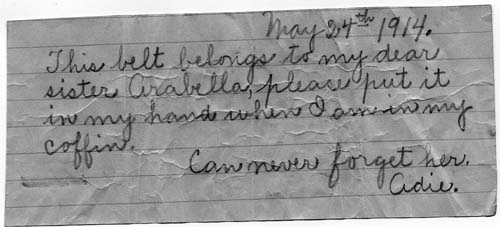
The baby was raised as Letitia French, later marrying and known as Letitia Welsh. She died on March 23, 1992. By using an online Social Security database, I was able to link her birth date to her married name. There were Welshes in the Milwaukee phone book. Her family did not know she was adopted. Raymond Lamboy married Imogene Peters in Berrien County, Michigan on October 23, 1907. Today, his family did not know that he might've fathered a child before marriage. John Raymond Lamboy was born August 21, 1889, making him 18 years old in 1907. He died in November 1962. Arabella's sister was Ada Jahn, my great-grandmother. She wrote this note six years after her sister's death. "May 24, 1914. This belt belongs to my dear sister Arabella, please put it in my hands when I am in my coffin. Can never forget her. Adie." |
 |
Ada married Frank Ramsthal. Ada and Frank's daughter Ellyne married Joseph Siefert. Ellyne was my grandmother.
In the 1970s, my mother Diana Foust researched our family genealogy. In her notes, I found a reference to Gwendeline, in a list of Jahn births to investigate. She never got around to it.
The genealogists at Find-A-Grave copied my pics and info from this page and created a useful summary memorial, including adding scans of the Northwestern article above, which we hadn't found before, and a scan of her burial certificate. Why they'd do all this without contacting me, I don't know.
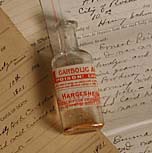
Carbolic acid, also known as phenol, would've been commonly available as a disinfectant. Highly poisonous, when consumed it caused a horrible reaction of vomiting and purging, delirium, and convulsions, as implied by the caddy's story above. It was a popular method of suicide. An ounce could be purchased at a drugstore for about fifteen cents. (The bottle shown above is not the actual bottle used by Arabella.)
In 2009, a relative of the Lamboys contacted me. In the course of their research, in the 1910 census they found an Arthur Lamboy at their residence, listed as a brother age 25, along with a lodger named Arthur Gill, age 20. The Lamboys were previously unaware of an eldest brother named Arthur, whose age might indicate he was a premarital child. Arthur Gill is closer in age to Arabella than Arthur Lamboy. He worked at the same company, American Appraisal, as did brother Louis Lamboy.
In 2014, I researched the history of Arthur Gill, on the notion that he was closer in age to Arabella. He was listed as an appraiser in the 1910 census, and indeed he remained one throughout his life. Arthur died in 1957. His two sons have since passed away. I spoke with one of their widows to try to determine if Arthur had any tattoos. Unfortunately, there may be no one remaining who would know.
Arabella's letters
At some point in her pregnancy, Arabella was sent to a private home for unwed mothers on Vliet Street. It was run by Theresa Seeling. She sent a number of letters to her sister Ada, who saved them, and they were found among my grandmother's possessions.
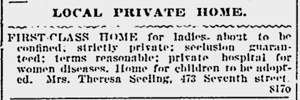 Seeling's advertisement in 1903

Milwaukee, Sept. 24, 07
Dear Sister,
I told Mrs. S how I thought I had to go on the toilet and she said that I should go as often as I can cause she thot that things lay right on the water bag and that ain’t good. She said I ought to have a syringe as soon as I could.
Pa was up Wed. night and brought me some nice candy. Mrs. S was just going to bed it was 8:15, she told the nurse to tell me that Pa should leave some money but he said he could tend to his own money matter and if she wanted money she should come down like a lady and ask for it and that was what the nurse said to.
I heard that Gordon was going to get married did you see the girl. I would like to see her and if she knew Gordon’s spunk. Oh my I suppose the first weeks or perhaps months he will stay to our house and thats just Ma hobby. He brought it up rather suddenly to Pa face about being put in the paper but I wonder if he ask his consent.
I don’t think I will have to stay here very long no more and neither does Mrs. S think so. When I get up in the morning my lips are just as blue and chap as they can be and you know my forhead is full of pimple cause I scratch them with my nails and Mrs. S tried to scare me and say that I have chicken pox and thats why things will come sooner but the nurse said how could I ever get them now.
If you have chicken skin (?) bring me a piece cause I have an appatite for a piece.
Ask Gordon through the phone if he would come up here
Well I will close and answer this letter.
Your Sister
Bella
Milwaukee Oct 17, 07
Dear Sister:
If Ma comes up to your house then come up here even it is in the afternoon. Mrs. Seeling was the same after you left cause she knew Ma and you would be up cause Ma always says Mon is a blue day for her. I had such an earache and the lady put something on that I thought my ear was coming off.
I wonder if there isn’t another place I could stay at cause here I can hardly eat anything unless she remarks how dear everything is and all such things. You forgot to tell me what Gordon told you over the phone.
I wouldn’t think of letting Ma pay five dollars for the board here cause its not worth it and its too exciting here that lady had the doctor for her girl again and he said she had (d) tonciledis but Mrs. Seeling said that she thinks its diperitha and that would be bad for her cause they would blockage the house then, she said to me I suppose you told your sister what I did Sat. night and added a whole lot to it. I said I only told her what a hurry up bath I had.
I ask if I could sit on the porch this afternoon and she said well I guess it to damp those girls in here room said yes I hope she croaks. Well I certainly will if I stay here very much longer cause it ain’t no use for me to live like this in such torcher and I won’t either but I will never say anything to Ma or Pa cause they have enough trouble as it is. Now cause I am writing this letter they told Mrs. Seeling that she should put me on the back porch and not let me sit in the front cause I was a disgrace to look on the way they talk but they only wanted that so the girls could laugh cause she told me to go in the back them girls need not talk cause if they were any to good they would not be here from other cities and besides they are none married either.
If Pa telephones to you before Friday you tell him not to bring me any fruit cause it all goes and yet out of a whole dozen I only had three bannas and one I gave to Noel thats four and then I had those apples well they knew I how many I had of them that’s why I did think they would take them.
Oh! If I was only home again I’d tell you that there wouldn’t be a girl happier than me as I can’t wait until then when I think how long it is.
Well I guess I will close my letter and don’t forget to answer it as soon as you can. Gee Adie some nights I feel like taking a walk down to your house but I would not dare to cause I know Frank would not like it and besides that would always bring a fight in the house with you and him.
Now for the second time I will close.
Your Sister
Bella
P. S. And write what your phone No is I lost it.
Milwaukee, Oct. 17, 1907
Dear Sister,
Well I got here alright and she never said a word to me. I was struck to she said well are you here so early and I told her that I was here before Mr. S. went away she didn’t know what to say then. She don’t say anything either but I ask the nurse if she did and she said yes Lillie now our little dishwasher is gone and you will have to get a busle on now and wash and peal your own potatoes.
I told Mrs. S that Gordon was over to and she said you must have had a family reunion I said we ate and then went to bed at 12-30. Yes I guess I did have a reunion in the bath tub you tell Harry through the phone that he should say Gordon was there but not him. Adie if it (wear?) where not for Lillie I would not have enoughs as I forgot mine at your house and she got these from Mrs. S. she (spit?) strike (?) them and just lucky I had my stamps or I would not have any one to get them from.
Come up Monday or Tuesday night with Ma cause then she is better.
See! I could of stayed until the next night but I would not wrist (?) it and you know how any one feels you never can tell who you are going to run into and that was not a bit to early either to get up.
Don’t forget my paper when you come. Excuse my fancy writing as I must do this in a hustle She didn’t want me to scrub today Oh! If only she where like that always.
It alright but I would not come over to the house not even in the evening someone might see me and we them. Answer this letter soon.
Your Sister
Bella.
Milwaukee Oct. 18 07
Dear Sister:-
I wish you would come up here to see me as I have no one to talk to but that hired girl that one girl that was in bed sick got up today and she don’t speak to me but they smear at me and maybe it don’t make me feel bad of coarse I haven’t got the blues enough but they have to make it worst for me. I never can stand it all for two months cause about seven or half past seven I feel so blue thinking it all over that it seems as though I don’t care to live but I suppose I will have to bear it all myself.
I don’t know what I would have done and been if were not for you cause it worried me so to think what would all happen perhaps the next day, but it ain’t no fun for me to be here and with it all cause this has been the first time I have ever been away from home. I mean to stay away if I were in another city like I wanted to go after I got well was only a dream cause I can’t stay away now.
You know I never would have told Ma or anyone but still I knew it most or something else to be done because to think that Ma would tell Pa was out of the question cause I thought Pa was so good I see it now and to let him know that I could not for I thought if he knew it he would tell me to go and turn me out for the house, but you know talk was easy from girls when they said well if Ma my Pa would ever turn me out I have a lots of friends that would take one and if they wouldn’t why a girl can always earn money (M) yes but how a ruined life to begain with and to end with yes and where to, in the (?) end no one knows where she is if alive or dead and no one care then not even her own parents care to know then.
When this is over do you know I would almost kill any one to know that they have ruined some young girl perhaps as old as I am not only to think they don’t give a rip for the girls you know it ain’t no fun to see a child that thought I might call my own go out into the world to earn its bread and butter and someday it will ask for its Mother and Father and what or who will it all you can’t say it is an orphan cause it is not even if it wear in an orphan home surely some one has made it and its some-one flesh and blood. If things would have been different I would like to know where I would been cause no one would take me in that would be a friend to you in the end and no one would care perhaps until some police or women would take until you were in the streets wandering a day no one know where.
I can it seems read the people and all their intentions that I would never believe any body I don’t care who it is cause they always look to have you in the wrong and slander you at all times just like when I was out with that Jessie in the auto see said what do you care if your parents scold they can’t do no more than kill you and surely I wouldn’t think for parents to kill their own child and then let them sit in jail for years this here is bad enough for me to sit and wonder and keep my mind off of it all but you know those kind of people don’t care if they kill because the think oh! Well I had my fun but only for a night but as Mrs. Seeling always says yes and so the play go around (? ??? ??? ???) must have a lesson from life to and look if I never had one I would never listen to Ma and look at the difference in sisters well they all say their must be one black sheep and I must be the one in our family.
But I am sorry for it all and know perhaps some day I might be forgiven but I will never forget it all. The next time you come bring me an angel cake if it ain’t too expensive for you I know I ask to much for what I done should suffer, I can hide that, and come over soon and bring Noel along. Come in the afternoon if you can. Well I will close.
Your Sister
Bella
Milwaukee, Oct. 29, 1907.
Dear Sister:
Adie you and Ma come up and get me as she won’t let me come cause she said that I must stay up and wait for Lillie every night till she comes home she is back again just like she was getting mean she makes me stay up but lets those big things to go bed when they like and they go early and I go late and I have to get up at the same time Lillie said that she can’t stop you if you want to go.
She ask me if I didn’t get enough to eat that I have to run to my sisters house. I told her that it was just to see Ma and she said I suppose then you can talk more about me but you won’t I will go with you to your sisters she has no right to go with me and and besides if she see your house she will wonder why you dress so poor then when you come.
It is getting fierce with her Sunday she offered me a nickel for candy she ask me if I had any money to buy some with I had the dime but I wouldn’t tell her cause she wants to see if I had any money and once she ask if I had two cents she ask me when Pa was coming up to give her some money and I said that I wrote back on the postal that he should be up to your house Wed and she said well I go to tonight is when he is suppose to come but you tell him through the phone not to come and then she can wait until next week Wed and let her whistle for it but don’t say to Pa that she can wait cause you know how he is.
She come in the room and said have you any matches then she was smart and ask to let her see your letter I don’t think that I have to keep in here just like prison life as we ain’t paying for that and when any other girls ask to go out she lets them but never ask me if I want to go down to a store on 30 and Vliet.
You come up as early as you can Ma and you then surely she won’t be home and I tell Dellphia (?) where going and she can’t kick just like last time she didn’t think I was home yet she made me get up this morning at 6 she is so mad and those girls are the same, picking on the smallest one they can. Well you know there is nothing to do after support but she says I want you for the kids and for one might think those other girls can stay up one at least never go to bed until late.
Don’t forget to come up.
Your Sister
Bella
Lillie is mailing this for me this morning.
Milwaukee, Oct. 31, 07.
Dear Sister:
When I got home she was up yet and drinking beer with that Chicago girl. Ma didn’t want to come in but Mrs. S. said go right out and tell your Ma to come in then she can see my new dress then she talk about the supper and it show that she never was to the Pfister for supper yet cause she told how they serve everything on small dishes and she said I thought we would have a good supper but when they came in they only brought soup in she did not know that was first course.
Next week either Tues or Wed you and Ma come and get me and then I will come over to your house and stay all night if that is if you wanted me to. You write and let me know before that and write a letter to me it only takes a few minuets to write and then I don’t get so lonesome. I thought shure when you didn’t come at 7 o’clock that you weren’t coming and I had to go and lay down on the bed and just cry it out. Well she said ???? package and ask before Pa and Ma if I had something good for her.
Ma and Pa acted so different I mean the way they talk it’s a wonder they didn’t start to fight for I thought every moment (?) It was going to happen. Don’t tell Mrs. S that you had rabbits for its none of her business.
Gee! Harry is getting to be swell in clothes. Well I might have been happy to and had nice clothes to but now look at it all I ????? for nothing more and just like Pa said is that the way you sit well that’s the way I feel about it all to. Noel will look swell and when I get out I will be able to go out with him.
Milwaukee, Nov. 3, 07. [Sunday]
Dear Sister:
If you telephone to Pa then tell him that he should tell Harry and Gordon if they want to come over Tues. night that is if you want to for when they come here every one listen and peek when we talk. I feel better since I used that I took the one you told me to.
Adie do you know if I tho that Ma wouldn’t think that the expense would not be to much I would like to have a least one dress and a few dippers and a short and a pr of stockings you could get the shirt and the stock at the 10 cent store when you would go down town but mabe Ma won’t let me buy and but I would like to have one fit for it.
I am only asking not saying that I must or have got to have it. Beshure and tell Pa to come as I will waiting and I don’t want to be disspointed. We have a new born up here I will explain it to you when I come.
Well close.
Ans. Bella
P. S. You tell Harry they should bring up a few grapes those red ones for me.
[ Ed.: On Wednesday November 6, 1907, Gwendeline Jahn was born. ]
[ Postcard dated November 30, 1907 ]
Mrs. F. G. Ramsthal
692 33rd Street
Local
I will be up but not until after supper as I know that we don’t want any one to see so tell Ma to wait for me. Keep some lunch for me.
Your Sister
Bella.
Google Map links
The Milwaukee Country Club was located near the intersection of Edgewood Avenue and Lake Drive. Here's the area today.
The Railway Exchange Building at Wisconsin and Broadway. Here's a detail.
Here is the Lloyd Street area today. It certainly looks like any old houses have been replaced.
Fourth Street School, today known as Golda Meir School. Golda was 8 years old in 1906 when she came to Milwaukee and went to school here. Read an excerpt of her autobiography, describing her first impressions of Milwaukee, including a peek into a barber shop.
The area where Theresa Seeling operated a home for unwed mothers.
- John Foust